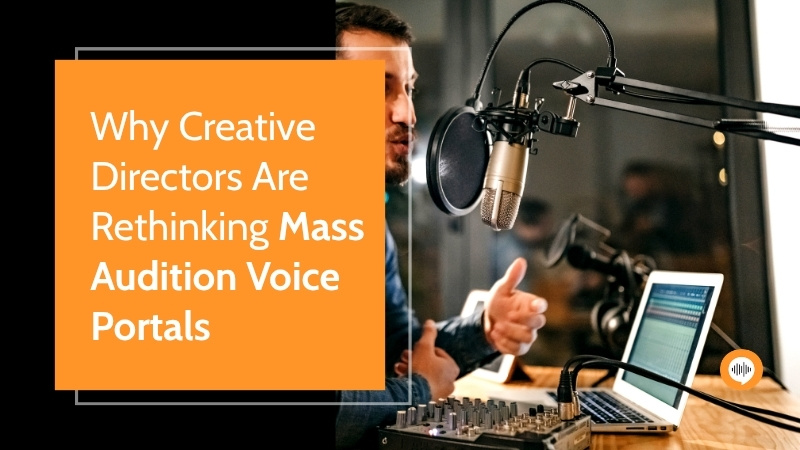
Why Creative Directors Are Rethinking Mass Audition Voice Portals
You’ve locked the script, signed off the creative direction, and set a tight deadline. All that’s missing is the right voice.
So, you post a brief and the auditions roll in. Some sound promising but come with a hum of background noise. Others are beautifully recorded but miss the tone or accent entirely. Before long, it’s 4pm, you’re on audition number 47, and the production hasn’t moved an inch.
For creative directors and production teams, the problem isn’t finding more voices. It’s finding the right one, with the performance and recording quality the project needs.
TL; DR
- More auditions don’t necessarily mean better casting results.
- Reviewing unsuitable recordings takes time away from creative decisions and production.
- Voice quality, recording equipment and technical compatibility matter as much as talent.
- Curated voice directories can help creative teams discover professional talent without relying entirely on open audition processes.
- The best casting approach depends on the project, deadline, budget, and technical requirements.
What Is a Mass-Audition Voice Portal?
A mass-audition voice portal is a casting platform where clients can post a project, receive multiple voiceover auditions and compare artists before selecting.
The advantage is, choice. You can access a wide range of voices, accents, languages, and performance styles in one place. But more choice doesn’t always mean a faster casting process.
When dozens of auditions arrive, your team still must listen, compare performances, check recording quality, and determine which artists actually meet the brief.
The challenge isn’t finding more voices. It’s finding the right one without creating more work.
Not every great-sounding demo is ready for production.
Background noise, inconsistent recording quality, and other technical issues can turn a promising audition into a production headache. Learn how to spot potential problems before making your choice in our guide to evaluating voice-over demos and identifying red flags.
Why Are Creative Directors Rethinking Open Voice Casting?
The issue isn’t access to talent. It’s time, relevance, and production readiness.
1. Too many auditions to review
A large pool can mean hours spent listening to voices that don’t match the accent, tone, style or brief.
2. Great voice, wrong recording
A strong performance isn’t enough if the recording has background noise, room echo or inconsistent audio quality.
3. The brief gets diluted
When casting becomes a numbers game, important requirements such as delivery style, audience and technical specifications can get overlooked.
4. More choice can slow decisions
A long list of “almost right” voices makes it harder for creative teams and clients to agree on the final choice.
5. Production deadlines don’t wait
The longer it takes to shortlist talent, the less time remains for recording, revisions and post-production.
The goal isn’t fewer choices. It’s better-matched choices.
How to Find Professional Voice Talent Without Wasting Time
A smoother process starts before you listen to a single recording.
Define the technical requirements. Set out the recording quality, file format, deadline and any platform specifications. If you need broadcast-ready audio, say so from the start.
Describe the performance you need. Instead of “professional British voice”, describe the delivery. Warm and reassuring? Energetic and persuasive? Understated and conversational? Add the audience and where the voice will be heard.
Shortlist artists based on fit. Look at accent, language, vocal character, experience and recording capability. Listen to complete samples where you can, because a short demo shows an artist’s best moment, not how they’ll handle your script.
Confirm the details before booking. Agree the fee, usage rights, delivery format, deadline and revisions up front. It saves misunderstandings later.
Build relationships with reliable talent. When an artist delivers the right performance and meets your technical needs, keep their details close. A trusted roster means you don’t start from scratch with every new brief.
Is a Curated Voice Directory Better for Advertising Agencies?
For agencies managing multiple campaigns, a curated directory can be a useful alternative to relying exclusively on open auditions.
It gives creative teams another way to discover talent, compare samples, and identify artists whose voices suit their clients.
The approach is particularly relevant when:
- You work with tight production deadlines.
- Your projects require reliable recording quality.
- You regularly cast for broadcast, radio or OTT.
- You need specific accents, languages, or delivery styles.
- You want to build a dependable roster of professional voice artists.
However, an open audition platform may still be the better choice when a role requires an unusual performance or when the team wants to hear fresh interpretations of the script.
The goal isn’t to eliminate auditions. It’s to use them where they add value.
A more focused way to find the right voice
If you’re looking to reduce the time spent sorting through unsuitable submissions, start by identifying the artists who already meet your essential requirements.
The Voice Finder is an online directory showcasing professional voice talent through a hand-selected, curated roster. It allows clients to explore artists and work directly with their chosen talent.
Browse the The Voice Finder talent directory to explore available artists by accent, language and other voice characteristics.
A more focused search can help you spend less time sorting through options and more time finding the voice that works for your production.
The Voice Finder connects you with production-ready talent
The Voice Finder connects you with professional voice artists who understand the technical requirements involved in broadcast, radio, and OTT voice-over delivery. Browse experienced voice talent for projects that require clean, production-ready recordings.
No avoidable technical setbacks. Just polished, production-ready voice talent for your next campaign.
Frequently Asked Questions
What is the best way to find professional voice actors?
Start with a clear brief, shortlist suitable talent and listen to samples before commissioning a recording.
Are curated voice directories better than audition platforms?
They can be useful when you want a focused selection of professional talent. Open audition platforms may be more suitable when you need a wider range of interpretations.
Why does recording quality matter in voiceover casting?
Poor recording quality can introduce noise, echo, and other issues that affect the final production. Always check that the artist can meet your technical requirements.
How can agencies speed up voiceover casting?
Use clear briefs, shortlist talent against defined criteria and maintain relationships with reliable voice artists.
 How UK and US Regional Accents Change the Way...