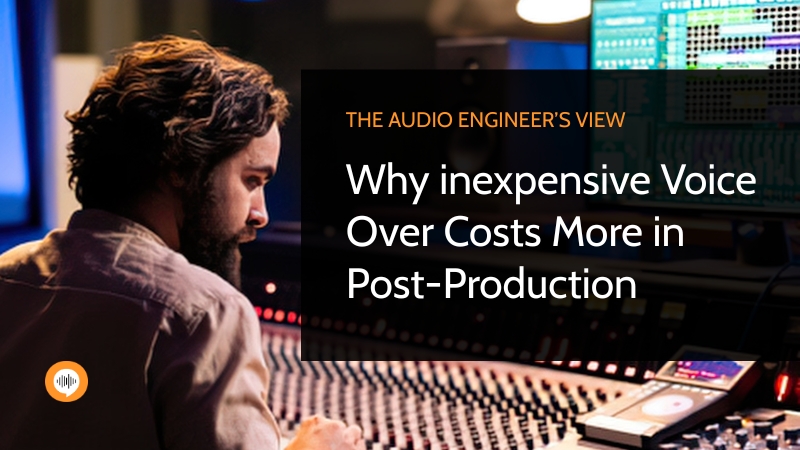
The Audio Engineer’s View: Why Inexpensive Voice Over Costs More in Post-Production
Ask any audio engineer who has worked in post-production for more than a few years about the file they dread most, and you will get a very specific answer. It is not a bad performance, actors have off days, and a quick re-take fixes that. It is the voice over recorded in an untreated room on inadequate gear that has to be dragged, kicking and screaming, into something broadcast-ready.
Inexpensive voice over rates look great on an initial quote, but low-quality raw audio always costs more in the long run. Here is the technical reality behind why cheap voice over options inflate your post-production budget.
1. “Fix It in Post” Is a Costly Post-Production Myth
There is a persistent myth that audio post-production software can fix any recording flaw. While Digital Audio Workstations (DAWs) effortlessly handle minor clicks, quiet volume levels, or awkward pauses, software cannot fully recreate the acoustics of a properly treated recording environment.
Reverb, room echo, and environmental noise are permanently baked into the digital audio waveform the moment they are recorded. When an engineer applies de-reverb plugins to remove room reflections, the software analytically guesses at the reflected signal and subtracts it.
That guessing process creates severe audio artifacts: a hollow, phasey, “underwater” sound quality that is often more distracting than the original reverb. Room noise can be reduced, but it can rarely be removed without destroying the natural quality of the voice itself.
2. Aggressive Noise Reduction Destroys Vocal Quality
Every noise reduction pass is a compromise between removing background noise and preserving the voice. The more aggressive the processing needs to be, the worse that trade-off gets.
When a recording contains fan rumble, PC hiss, or room hum, an engineer must apply heavy noise reduction. This introduces noticeable vocal degradation:
- A subtle warble on sustained vowel sounds
- A complete loss of high-frequency “air” and vocal presence
- A robotic, synthetic, and heavily processed voice tone
The primary reason for hiring a professional voice actor is authenticity and warmth, the exact qualities most easily destroyed by heavy noise reduction. An engineer spends double or triple the billable hours trying to strike a balance between passing audio Quality Control (QC) and keeping the voice natural. If no balance exists, you are forced to pay for a full re-record.
3. Broadcast Loudness Specs Leave Zero Margin for Error
If your voice over is destined for television, radio, commercial broadcast, or major streaming networks, it must pass strict technical compliance standards before airing:
- EBU R128 (European Broadcast): Requires -23 LUFS integrated loudness (±1 LU tolerance) with a true peak ceiling of -1 dBTP
- ATSC A/85 (US Broadcast): Mandates –24 LKFS. Under the CALM Act (passed in 2010 and enforced starting in 2012), it is illegal for a commercial to air louder than the surrounding program
- Streaming Services: Require strict platform targets, typically between -16 and -18 LUFS
Meeting broadcast specs is straightforward on clean audio with a high signal-to-noise ratio. On a noisy or low-level recording, pushing up the volume pushes up the background noise floor in exact lockstep. The engineer is forced to choose between failing loudness specs or boosting background hiss to unacceptable levels.
4. Direct Cost Comparison: $150 Quote vs. $400 Quote
Comparing voice talent quotes at face value such as $150 versus $400 for the same script, only works if both options yield the exact same finished asset.
- The $150 Untreated Home Setup: Arrives needing hours of repair work, including surgical de-noising, room EQ compensation, de-essing, aggressive level automation, and potentially a full re-record session. Adding two to three hours of skilled post-engineering fees quietly transforms the “budget” option into the most expensive invoice
- The $400 Treated Professional Studio: Arrives broadcast-ready. It requires only minutes of level matching and minor taste EQ. Post-production engineering time is kept to a minimum because the source material was recorded correctly
These figures are illustrative rather than universal rates. Actual costs vary by talent, project scope, market, studio setup, and post-production requirements. The same principle applies whether you are commissioning a voiceover in the US, UK, or Europe: the cheapest initial quote does not necessarily represent the lowest total production cost.
5. The Domino Effect on Video Production Timelines
Beyond direct engineering bills, poor audio quality introduces a major risk for creative directors and video editors: unpredictable schedule drift.
When clean audio arrives, audio mixing follows a predictable timeline and wraps up in an hour or two. When compromised files arrive, production schedules stall:
- Review Bottlenecks: Engineers must bounce multiple test mix passes to check if digital artifacts pass project standards
- Cascading Delays: Video editors, motion graphics artists, and colorists are left waiting for finalized master audio bounces before rendering final deliverables
- Emergency Re-Bookings: Failing broadcast quality control at the deadline forces talent re-bookings, pushing campaign launch dates back by days
In commercial media production, schedule delays equal lost revenue. A delayed campaign launch often costs far more than the initial price difference between amateur and professional voice talent.
6. Client Experience and Brand Perception Risks
Technical specs and timeline delays aside, compromised voice recordings hurt how audiences perceive a brand’s authority. Human ears are remarkably sensitive to unnatural vocal processing and poor room acoustics.
- Loss of Trust: Processing artifacts make a voice sound thin, artificial, and cheap, subconsciously signaling low production value to potential customers
- Listener Fatigue: Audio recorded in echoey, resonant spaces forces the listener’s brain to work harder to parse speech, leading to lower content retention
- Brand Inconsistency: Varying audio quality across marketing channels erodes the polished image a company works to build
Clean audio is not just a preference for sound engineers, it is an essential component of audience retention and brand trust.
What a Treated Professional Studio Actually Delivers
When you hire professional voice talent with a dedicated acoustic space and commercial-grade signal chain, you pay for three core guarantees:
- Controlled Acoustics: Zero room reflections, slap-back echo, or boxy frequencies to scrub out in post
- Ultra-Low Noise Floor: Clean vocal signals sitting well below broadcast rejection thresholds
- Professional Mic Technique: Natural control over proximity effect, plosives, and vocal dynamics without needing take-by-take editing
Start With a Clean Source: Discover Verified Talent
The best post-production is the post-production you barely have to do. Choosing talent who already record in a properly treated space with professional-grade gear isn’t an upsell, it’s the single decision that determines how many hours of engineering time (and how much schedule risk) sit between your session and your finished, broadcast-ready file.
The Voice Finder only accepts talent with professionally produced demos and carries out quality checks on the studios and recording spaces they use. This provides an additional layer of confidence that the audio quality you hear in a polished demo is supported by a suitable recording environment.
The Voice Finder’s directory lets you filter voice talent by studio connectivity, location, and specialty, so you can see exactly what kind of studio setup you are working with before you book. With a strong presence in the UK and Europe, alongside talent in other markets, The Voice Finder supports clients looking for professional voiceover talent across regional, national, and international projects. Connect directly with verified, broadcast-quality voice artists with zero middleman fees.
 Writing Effective Voice Over Specs: How to Ge...